
Tekelijanum
A Serbian Pantheon in the heart of Pest
A Serbian Pantheon in Pest
Tekelijanum was the most important Serbian cultural and educational institution outside the Serbian homelands in the nineteenth and the first half of the twentieth century. It was founded in 1838 in Pest, in the very heart of present-day Budapest, by Sava Popović Tekelija – a nobleman, the first Serb to hold a doctorate in law, and lifelong president of Matica Srpska. This endowment was the third official central institution of the Serbs in Hungary, after the Serbian National Theatre (1812) and Matica Srpska (1826), and over time it became the centre of the spiritual, literary and national life of the Serbian community in the Habsburg Monarchy.
Behind the endowment stood a clear idea: to provide poor but most gifted Serbian pupils and students from all the regions where Serbs lived with free lodging, board and a scholarship during their studies at the University of Pest. The future of an entire stratum of the Serbian intelligentsia depended on Tekelija's drive.
I — VisionEducation as the lever of a nation
Even as a young man Tekelija arrived at a conviction that accompanied him throughout his life: that education is the main lever for raising the Serbian people towards a better future. He was a friend and like-minded associate of Dositej Obradović, with whom he was acquainted and corresponded, and even before founding the endowment he personally set aside considerable sums for the schooling of Serbian youth. Childless, in advanced years he decided to direct his entire estate – inherited from the old Arad merchant and noble family Popović and increased by his own service and business – towards the education of his people.
In 1837, at the urging of Teodor Pavlović, then secretary of Matica Srpska, Tekelija bought in Pest for fifty thousand forints an old, dilapidated house from the mid-eighteenth century and renovated it so that twelve residents could be accommodated in it. The intention was clear: the same building was to contain a student dormitory, the offices of Matica Srpska and the apartment of its secretary. Thus from its first day Tekelijanum was conceived as a living cultural organism, and not a mere boarding school.
The initial fund
On 21 August 1838 Tekelija drew up the so-called Founding Letter, the founding charter by which the institution officially came to life. With it he also handed over all his movable and immovable property to Matica Srpska for management. The initial fund of the endowment was exceptional by the standards of the time: about one hundred and fifty thousand forints in cash, two houses in Pest, several houses in Arad, fields, meadows and vineyards, and twenty-eight acres of land beside the dormitory itself. At first the dormitory took in twelve residents, and when revenues from the estates began to grow, that number was raised to twenty.
At the same time, in 1839, Tekelija also handed Matica Srpska a bond for twenty thousand forints, the interest on which maintained the residents. A year later, in a will signed in Pest, he named his Endowment the chief heir of his entire property. When he died suddenly on 21 September 1842, his whole property holdings – estates, houses, cash – flowed into Tekelijanum and Matica Srpska.
The residents of Tekelijanum
From its founding until the First World War, that is, over a little more than seven decades, more than three hundred and fifty pupils and students passed through Tekelijanum; according to some sources, by the end of the Austro-Hungarian era that number exceeded four hundred. The list of residents reads like a gallery of the brightest names in Serbian science, literature and public life of the nineteenth and early twentieth century. Here, in different eras, lived, studied or worked:
In 1866 Svetozar Miletić launched the newspaper “Zastava” in the Tekelijanum building, then the most important political organ of the Hungarian Serbs. Tekelijanum itself remained in the memories of its residents as a place of strict discipline and spiritual fire. Veljko Petrović recorded that, even in the time of his residence, a story still circulated of how the eighty-year-old founder personally locked the gate and, with a lantern, searched the surrounding taverns for pupils who had slipped out into the night after hours.
IV — The spirit of the placePreodnica and the Circle of Young Serbs
Tekelijanum was not just a boarding school – it was an incubator. In 1860, Kosta Ruvarac, a resident barely twenty years old, with the help of his older colleague Laza Kostić, founded within the dormitory the cultural and literary society “Preodnica”. During the sixteen years of its existence – until 1876 – Preodnica gathered young Serbs at literary evenings and discussions on language reform and the national question, and many later public figures emerged from it. When Preodnica was dissolved, its place was taken in 1880 by a new literary and benevolent society under the name “Circle of Young Serbs”.
V — Seat of the MaticaHome of the Mother Institution
From 1838 to 1864, the Tekelijanum also housed Matica Srpska — the oldest and most important Serbian cultural institution, founded in 1826 in Pest. The ceremonial hall on the ground floor of the building was its working seat; in the basement stood the printing press that Tekelija had acquired and donated to Matica, and from which the society's first books were issued. When Matica Srpska was ceremonially moved to Novi Sad in 1864, it remained the administrator of the Tekelijanum — until 1878, when the Hungarian authorities forced it to hand over the administration to the Serbian Orthodox Church Municipality in Pest.
Tekelija's personal library — according to surviving inventories, one of the richest Serbian private collections of the eighteenth century, with about four thousand volumes in some fifteen languages — was transferred to the home in March 1843, a few months after his death. The collection grew over the decades and by 1948 numbered more than ten thousand volumes. Today it is kept in the Library of Matica Srpska in Novi Sad, where part of Tekelija's legacy is available to readers in the form of more than seven thousand surviving books.
The Old and the New Building
The first building of the Tekelijanum, the one that Tekelija personally bought and renovated in 1837–1838, was a modest two-storey house resembling the typical Pest townhouses of the mid-eighteenth century. By the early twentieth century the building had fallen into disrepair, and its location became a matter of interest to the Budapest city authorities, who wished to extend their Magistrate building on the site. Negotiations over the purchase were long, but the Hungarians eventually gave up because of the excessive price.
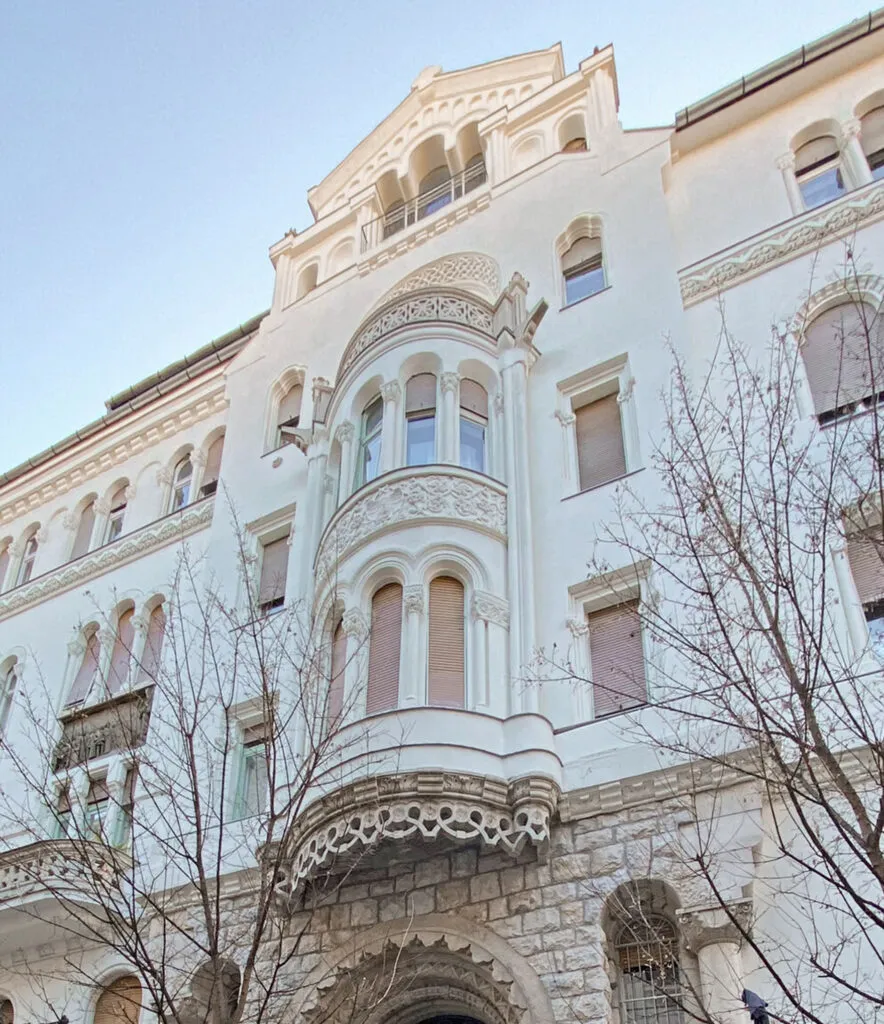
By decision of the Patronate — a special spiritual and administrative body that took over the care of the endowment in 1902 — the old house was demolished in 1906. The foundation stone of the new Tekelijanum was ceremonially laid on 10 November 1907, and the four-storey palace was completed and occupied in 1909. Designed in the spirit of late Secession with discreet references to medieval Serbian architecture, the new palace at 17–19 Veres Pálné Street is one of the most representative Serbian buildings in Central Europe. The decorative elements of the façade and interior are clad in the famous ceramics of the Zsolnay manufactory in Pécs — the same material that adorns many prestigious Hungarian buildings of that era, such as the Parliament building and the Museum of Applied Arts.
The building was divided into two wings: wing “A” housed a boarding house for Serbian pupils, and wing “B” contained flats for rent, the rents from which financed the running of the home. The original stained-glass windows, chandeliers, lamps, locks, wall ceramics and painted Secession ornamentation — all of this has been preserved or, during later restoration, carefully returned to its original state.
VII — DarknessUnder Lock and Key
Between the two world wars the number of residents gradually declined — inflation and the currency changes in the Kingdom of Hungary devalued the fund's cash, and part of the building had to be let out for rent merely to keep the endowment going. Despite this, in the period 1941–1944 the home partly recovered, with more than thirty residents under its roof. The real and almost fatal blow came after the Second World War: in 1952 the Hungarian communist authorities nationalised the building and abolished the endowment.
For the decades that followed, this vast, stately building in the very heart of Budapest stood locked and forgotten. Bishop Lukijan of Buda later described that period as a time when behind the padlock of the Tekelijanum lived a scene from a horror film — a place through which Serbian cultural life had flowed for centuries was now silent, dusty and inaccessible.
VIII — The ReturnRenewal of the Mission
The first change came in 1991, when Hungary passed the Act on the Partial Return of Church Property. On that basis, five years later, in 1996, the Serbian Orthodox Eparchy of Buda received back half of the building — in very poor structural condition. The other half is still being gradually bought back, in agreement with the residents' community. From 2005 to 2012, in several phases, construction, restoration and conservation works on nearly a thousand square metres of space were financed from the funds of the Provincial Government of the Autonomous Province of Vojvodina in the amount of about ninety-one million dinars (approximately 630,000 euros at the time).
The works were carried out by leading conservators, and the interior in the post-Secession spirit, with decorative motifs taken from Serbian medieval architecture, was made entirely according to the original. Every lock, every stained-glass window and every fragment of painted ornamentation was returned to the condition corresponding to that of 1909. The ceremonial opening of the renovated premises was held in May 2015, in the presence of the President of the Provincial Government and the Bishop of Buda.
IX — TodayThe Tekelijanum in Our Time
After Hilandar, the Tekelijanum is the largest Serbian endowment outside the home country — and at the same time the largest Serbian cultural and educational institution abroad. Today it is managed by the Patronate, headed by two co-presidents: the Bishop of Buda and Timișoara and the President of Matica Srpska. The owner is the Eparchy of Buda of the Serbian Orthodox Church.
The main purpose of the building has remained faithful to the vision of its founder. In the boarding section, on the third and fourth floors, live and study pupils of the Serbian Primary School and Gymnasium “Nikola Tesla” in Budapest — children from the Szentendre area, Vojvodina, Republika Srpska and other parts of Serbia. The ceremonial hall, which until 1864 was the seat of Matica Srpska, is still used for formal gatherings, exhibitions and lectures. In the hall a permanent exhibition of portraits of members of the Tekelija family has been installed, a gift of the Gallery of Matica Srpska. After one hundred and seventy-seven years of uninterrupted existence — even if with a long interruption — Sava Tekelija's endowment continues the mission that its founder inscribed in the founding charter: to be, for the Serbian people, a house of learning and spirit, built of stone, but even more of books and of the light given by education.
Sources and Literature
- • Matica Srpska: Matica Srpska 1826–1926, chapter on the founding of the Tekelijanum
- • Željko Fajfrić, Sava Tekelija — the First Serbian Doctor of Law
- • Archive material of the Eparchy of Buda of the Serbian Orthodox Church and of the Tekelijanum Patronate
- • Dragan Stanić (President of Matica Srpska) and Dr Saša Jašin (Eparchy of Buda of the Serbian Orthodox Church) — interviews for BBC in Serbian
- • Articles: RTS, Vreme, Večernje novosti, BBC, Rasejanje.info, Giving Balkans
At a glance
Related
Literature and sources
This list is for further reading and verification. Online sources were checked on 30 September 2026; books and medieval sources are recommended reading, not sources for individual statements on this page.
Online sources
- Lazar Mečkić, “Establishment of Tekelijanum”, Novi Bečej (Theodor Pavlović pages)
- Matica Srpska
- Serbian Academy of Sciences and Arts
Further reading
- Irena Zečević, Aleksandar Radović, „Biblioteka Matice srpske na osnovu bibliotečke građe i izvora iz posebnih zbirki BMS”, Bibliotekarstvo Srpske 8 (2019), 36–57.